Nevers Dam

The St. Croix River has a long and storied history. From Native Americans who lived and traveled on the river, to the trappers and traders passing through, and the loggers and settlers that followed. As lumbermen discovered more of this area of Wisconsin for their sawmills, the river soon became the main transportation for the hewn timber. As more and more logging companies used the river, it soon became a hazard for boats on the river and for lumber companies in Stillwater to verify the millions of feet of logs that were floated downriver. This also became a regular scene for some amazing log jams. These jams would not only stop the work at the sawmills, but they would endanger the lives of the loggers on the river and oftentimes would halt river traffic completely. Massive log jams sealed off the river in 1865, 1877, 1883, and 1886 causing not only headaches but also, more importantly to the lumbermen, a loss of profit. It was finally decided that the river needed a dam to regulate the flow of logs and the level of water on the river.

The Nevers Dam, rumored to be the largest pile-driven dam in the world at one time, was built in 1890 and was used to control the large flow of logs that came down the St. Croix River from the logging camps up north down to the sawmills in Stillwater. Costing over $200,000, much of the dam was built by hand with little help from steam powered equipment. It was used heavily for only a short period of time, until 1912-1913, but was not demolished until 1955 after spring floodwaters severely damaged its integrity. The dam structure had previously withstood a 70-foot crest of the river in 1950, which was an all-time high.

There were an average of 30 people working at the dam during the logging heyday. This includes workers who blasted ice flows apart in winter, worked at the sawmill, sluiced the logs through and downriver, and, of course, the cooks.

Nevers Dam also held some unique features, including an electric light (or rather a generator powered carbon light) system installed in 1889, which allowed work to continue around the clock. This was such a new invention that people drove from miles away to see the lights. It also held a specially designed 80-foot-long submerged gate, called the “Lang gate” that would sluice large numbers of logs through. It could handle approximately 4,000,000 feet of logs per hour, a huge sum at the time!

Other highlights during construction of the dam described in the St. Croix Valley Standard newspaper include:

  • “Mr. Thomas Wright is kept very busy now, cooking for 285 men”

  • “Mr. Register claims that the party who substituted potatoes for his apples did not fool him very badly”

  • “Mr. Carrigan claims that dry hard wood placed in a bed does not add to the heat of the room”

  • “A human skeleton was unearthed at the gravel pit on the east side of the river. It is supposed to be the bones of an Indian, as there once was a trading post at this place”

  • “Isaac Register received quite a serious injury last Friday by a heavy timber falling on him, but he is now up and around again”

  • “Guy Matthews received quite an electric shock on Monday evening, caused by the electric light wires crossing the cable used in hauling cars”

  • “The boys have organized a society known as the Damville Codfish club. Sobriety and a knowledge of etiquette are among the numerous essential qualifications for membership”

The men involved in the construction of the dam appeared to be a close-knit fun-loving group of fellows as evidenced by many of the above story clips. This is likely due to the dangerous nature of their work. In fact, the construction of the Nevers Dam was dangerous enough that two men lost their lives. Andrew Anderson died by falling in a mass of gravel and Wm. Webb fell into the water while painting a gate and was dragged into the undercurrent at the foot of the dam.

Eventually the Northern States Power Company acquired the dam and used it for a couple decades to control stream flow and regulate power production at the Taylors Falls hydroelectric plant. Eventually the Army Corps of Engineers ordered the dam remain open and the stream should be regulated from June through October. As the dam did not serve any commercial or environmental purpose, not to mention the damage it received from flooding in the 1950s, it was deemed too hazardous and was removed.

Source:

Vezina, R. 1975. Nevers Dam...the Lumbermen’s Dam. Standard Press.

Polk County's Will-O'-the-Wisp

Ask the New Merriam Webster Dictionary what a will-o’-the-wisp is and you’ll get the following definition: “a delusive or elusive goal.” You’ll also get an origin of the phrase. “The will-o'-the-wisp is a flame-like phosphorescence caused by gases from decaying plants in marshy areas.” Historically, it was personified as "Will with the wisp," a sprite who carried a fleeting "wisp" of light. “Foolish travelers were said to try to follow the light and were then led astray into the marsh. (An 18th-century fairy tale described Will as one "who bears the wispy fire to trail the swains among the mire.") The light was first known, and still also is, as ignis fatuus, which in Latin means "foolish fire." Eventually, the name will-o’-the-wisp was extended to any impractical or unattainable goal.”

If anyone has seen The Lord of the Rings: The Two Towers, this will sound familiar. As Frodo and Sam traverse the Dead Marshes, Gollum tells them not to follow the lights, or they’ll soon end up joining the dead ones. But this is a common story told among people who have lived near marshes or bogs for centuries. In fact, one Polk County man experienced his own will-o’-the-wisp!

Worthy Prentice, in his book Reminiscences of Early Pioneer Days in Polk County tells about a mysterious fire around 1862. “A man by the name of Joseph Corey lived on the west bank of East Lake, the Soo R.R. ran through the farm between Nye and Dresser Junction. This mysterious fire would spring up at intervals on the place. The fire would come up out of the ground in a round blaze and about three or four inches of the top of the blaze would resemble the blaze of a candle, the rest of the blaze would be as blue as Indigo. It looked very queer to me as I saw it myself.'“

The fire got to be bad enough that Joseph had to relocate due to it burning all of the buildings on his farm and a large amount of his family’s clothes. Joseph moved to the farm adjacent to Prentice’s father.

In addition, the same year of the fires, a large number of fish died in East Lake and would drift ashore in rows. This led to speculation of a gas leak of some kind being the cause.

Prentice closes by wishing that one of his neighbors had undertaken an experiment to see if coal oil or another combustible substance could have been found nearby. “I only wish that I could stay long enough to see if thoroughly investigated. It was a wonderful phenomenon.”

A Polk County Man's Experience in the Klondike

When organizing the thousands of documents in our archives, we often come across fascinating news stories, correspondences, and, in this case, genealogical stories.

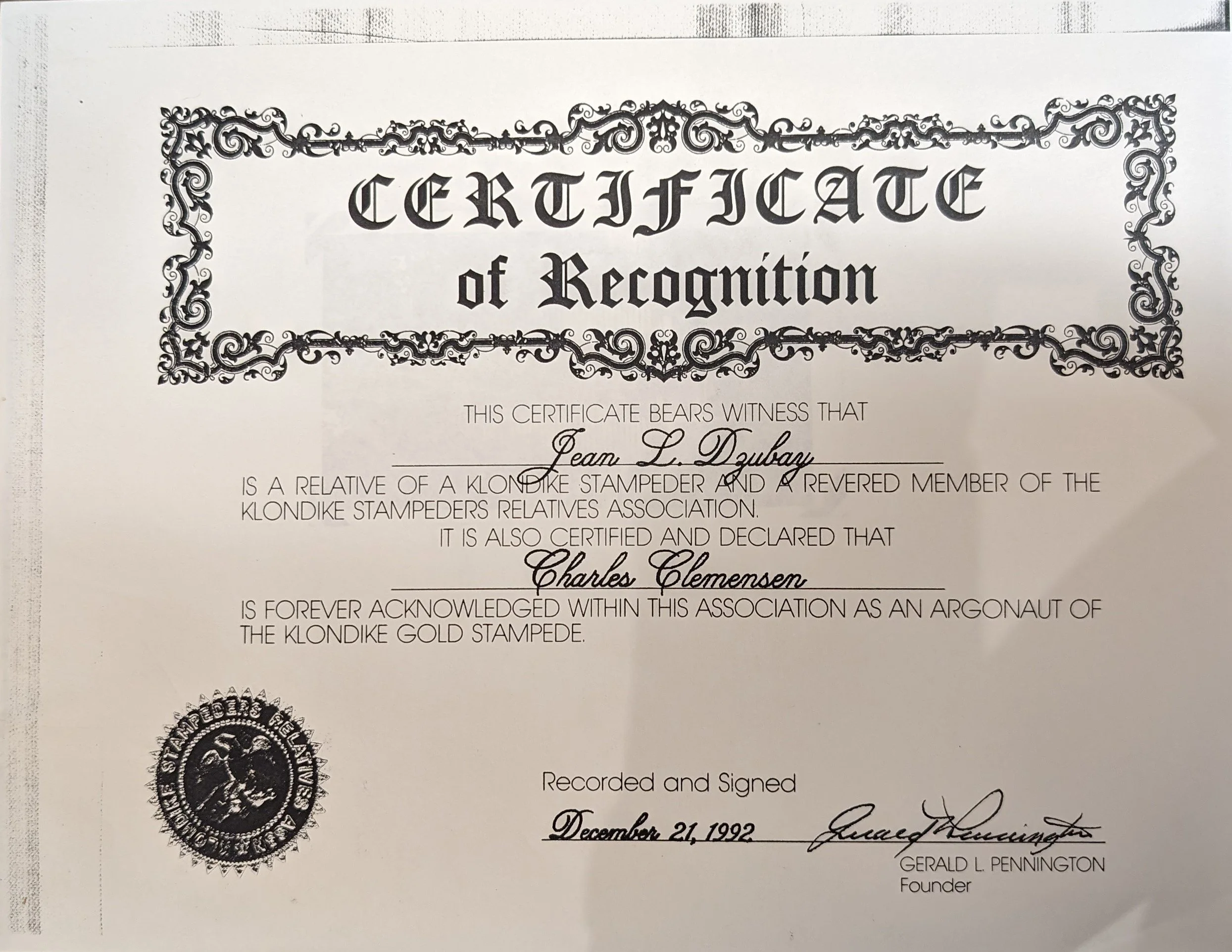
The following story was written by John “Jack” Clemenson, son of Charles Clemenson, the protagonist in our story. Charles was born in Lolland Denmark in 1864. In 1882 Charles began his journey to the United States. Charles spent $80 and took the three-week journey from Denmark to New York confined in one room on board a ship. Most of the other men on board were confined to this same room, spent most of the journey ill and in bed, and were fed boiled potatoes and tea lowered into the room in a kettle on a long rope. Upon arriving in New York, Charles immediately came to Deer Park, Wisconsin to visit his brother Paul. Charles gained employment with the St. Croix Lumber Company at South Stillwater (now Bayport) during their logging season (April to November) for fifteen years. What follows is a collection of some of his experiences while living and working in the area, with a specific focus on gold-digging trip he took to the Klondike.

Charles worked a variety of logging jobs including scoot tender, sled tender, skidway tender, oxen driver, log turner on skidway, steamer, roustabout, surveyor. He also worked in a variety of places between 1883 and 1911 including Stillwater, MN, Gordon, WI, Spooner, WI, Spring Brook, WI, Kennen, WI, New Richmond, WI, Williston, ND, and the Klondike.

According to Charles, he ended up in North Dakota due to issues with his boss in Bayport. Charles reportedly told his boss to “go to hell” and his boss sent him there.

During each of his stays in the logging camps, there was a specific routine for Charles and his fellow loggers to follow. Lights on at 5:30 AM, off at 9:00 PM except Saturday nights. The camps had a stag dance every Saturday night with a mouth organ and/or a fiddle for music. Sundays were left for washing and mending. Beds in the camps were double decked, two men to a bunk, with pine boughs for mattresses and two blankets (one over and one under).  Breakfast every day consisted of meat, potatoes, hot biscuits, coffee, and tea. Lunch in the woods consisted of beans, meat, potatoes, bread, pie, and tea. Dinner at camp included beef, potatoes, bread, sauce, tea, and coffee and was served promptly at 6:30 PM.

In February 1898, Charles and a group of 11 other men left Stillwater for the Klondike. Each person in the party was provided 1,200 pounds of food, two blankets, one tarp, and a tent for four people. Each person was also issued a hand sled, pick, shovel, gold pan, axe, and crosscut saw for two people. Overall, the cost per person was $110. The group arrived at Lake Bennett in April 1898 with all their gear, including a recently purchased horse, and waited for the ice to break up.

Once the ice broke up, Charles and his group traveled north to Dawson, with more purchases including hiring a Native American guide to get their boats (and gear) across a set of dangerous rapids for $25 per person. Prices in the Dawson area were high, even by 1898 standards and everything was paid in gold dust.

From their hand-built log cabin outside of Dawson, Charles and a small group of men took a 100-overland trip to the headwaters of the Klondike River to search for gold. They built a raft to travel back down the river. The group made it approximately 25 miles back downriver before their raft hit a submerged log and overturned where they lost almost everything but their blankets in the process. Charles could not swim but was saved by grabbing a bundle of blankets and floating to shore. One member of the party was in bad shape and was sent downriver with two moose hunters in a canoe who happened to come by just after the accident. The other seven party members purchased some moose meat from the hunters and started the long hike back. Unfortunately, all their matches were soaked in the accident and they had to survive on raw moose meat and wild currants on the three-day trip back.

Charles took a few jobs in 1899 and 1900, one on a producing gold mine. Charles was the bottom man in a “drift,” digging up gravel. He would build a fire in the hole in the evening, which would burn all night to thaw out the gravel to be hoisted out the following day. The ground was constantly frozen and thus they needed to burn their way down.

News traveled slow in the late 19th and early 20th centuries, particularly if you were a gold miner way up in the Klondike. So, if someone got their hands on a newspaper, it was a big deal. However, folks also took advantage of that fact. Charles found himself the victim of someone looking to make a quick buck. A man came to Dawson, and he managed to get his hands on a newspaper from another passenger that came up in a boat. This man proceeded to rent a building and advertised that he would read the paper on a certain night for a $2.50 admission fee. Charles and others fell for it and went to get the news. But this man sensed the opportunity to make more money so he read one page then announced he would read another page the following evening…for a $2.50 admission fee. Thankfully it doesn’t seem like Charles fell for it a second time.

In the fall of 1900, Charles was in Dawson watching someone unload a boat of supplies and decided on a whim to ask for a job on the boat. Within an hour, Charles had left Dawson, and the Klondike, behind to head back towards Polk County, Wisconsin. Charles returned to Osceola on September 26, 1900. He then purchased forty acres of land in Black Brook township (near Amery) and moved his family up there. He eventually accumulated 200 acres of land and spent the remaining days of his life on the farm until he passed away on October 30, 1943.

Certificate of Recognition for a relative of Charles Clemensen, who was recognized as an argonaut of the klondike gold stampede