
The Story of Hope
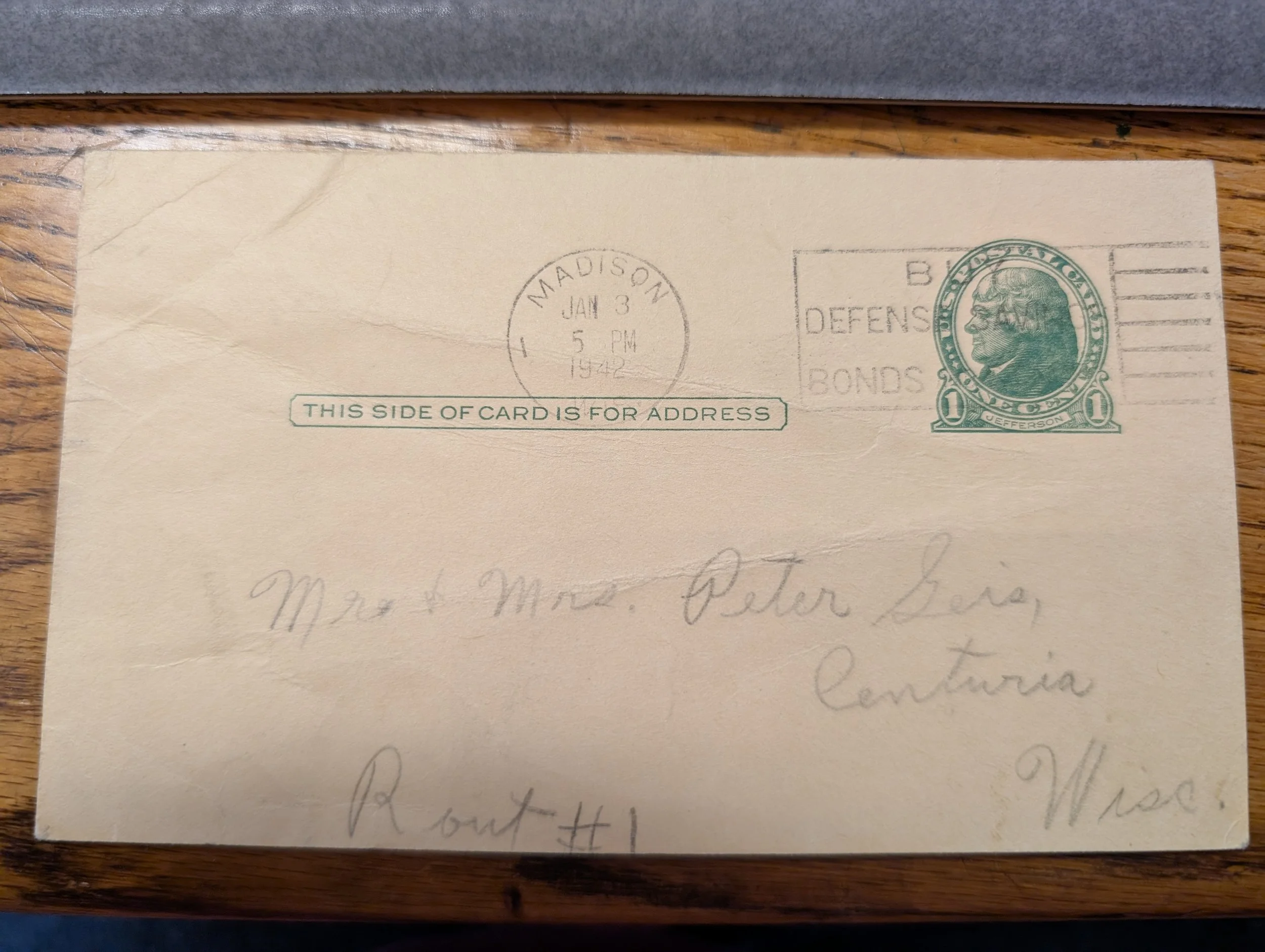
Postcard addressed to Herman’s parents from Herman, 1942.
While organizing our archives, we came across a small binder with the title page “Herman Geis’s Postcard Story of Hope.” Naturally, we had to see what was inside. A postcard collector and retired teacher, Dan Hovland, purchased a set of post cards on sale at an antique show in Roseville, Minnesota in 2008. The postcards, dating from September 25, 1941 to December 8, 1942 chronicle the hospitalization and care of one Herman Geis for polio. Told through 70 postcards sent from Madison (and later Eau Claire) to Herman’s parents Mr. and Mrs. Peter Geis, Herman details his time spent in treatment for a disease that would have most likely forever changed his life.
Polio (also known as poliomyelitis or infantile paralysis) is an acute and highly contagious viral infection that, until Jonas Salk invented the polio vaccine, was feared word around the world. While most who were infected would only experience mild symptoms, for some it could lead to meningitis, paralysis, and death. To save anyone from fearing the worst, Herman did survive his bout with polio and returned home following his treatment.
Conventional treatments for polio involved placing the affected limbs in plaster casts in an effort to prevent deformities. Unfortunately, the casts led to muscle atrophy. However, a pioneer Australian bush nurse named Sister Elizabeth Kenny developed a new treatment approach, which she brought to the United States in 1940 to share with medical professionals. Her method included hot compresses on the affected limbs along with passive movement of the areas to reduce spasms. Sister Kenny stayed in the United States, with Minneapolis as her home base, for eleven years. Sister Kenny’s methods went from controversial to the preferred method of polio treatment before the vaccine was developed. This was likely the case with Herman’s treatment; it appears Herman’s treatment changed from the original cast treatment to Sister Kenny’s compress and movement methods.
According to former Polk County Historical Society board member, Steve Sylvester, Herman was an active member of the Centuria village council, the fire department, and the water and sewer department. Herman was also a police officer in the 1950s and 1960s, married, and had two children. Herman died of a stroke in the 1980s.
Below are excerpts from Herman’s postcards sent to his parents during the course of his treatment in Madison and later Eau Claire. We have kept the grammatical errors and punctuation the same as Herman originally wrote them 75 years ago.
September 25, 1941: “I am geting along fine so far. How is Sport? is he lonesome for me? when are you coming down to see me? I can’t roll on my side no more. They got sand bags on the side of my legs.”
September 27, 1941: “Well they got casts on my legs to keep them from getting crooked. The name of my doctor is Dr. Skkema. She is a woman doctor. I have to lay on my back all the time. I got a radio here but I can only get two Madison Stations. I made common [communion] this morning.”
September 29, 1941: “I am getting pretty restless here latly. They have been giving me pills. As you know my doctor’s name is Dr. SKKEMA. I call her Dr. Sicklmore.”
October 1, 1941: “How are you? I hope you are all fine. They think that I have to stay here for six weeks. My legs have more feeling in them. They haven’t had that felling like pins for a long time so I am geting along just fine. I can eat every thing I want sometimes.”
October 6 (dated October 5), 1941: “I am glad to hear that you are coming to see me. and I hope you bring me some candy! the radio cheers me up. [Added at top]: would you bring my little cars, airplanes, bus, in that match box?”
October 16 (dated October 15), 1941: “I got your card today. They to [took] me over to the doctors. They looked me all over and said that I am get[ting] a little better. I just got throwr [through] eating dinner. I forgot to tell you that they put oil on my legs to get the skin soft and to help my legs get well.”
October 24 (dated October 22), 1941: “They gave me a punch in the back yesterday it did not hurt much. I am geting so that when they stick me wich [with] a neatill [needle] it don’t hurt.”
October 28, 1941: “Well I am in a ward now and I am haveing a good time. My left leg is just about the way it shoud [should] be. My right leg is geting better. They think that [it] won’t even have to have a brace on my foot or leg they think I will have to use a cane for a while. One of the meanist boys went home today and I am gald [glad]!”
November 18, 1941: “I am sorry I didn’t write sooner but I haven’t had time. I am in a differnt ward now. I am going to get a new cast Monday. My legs are getting a lot better. My right leg is [a] little better now. My left leg is real good now.”
January 2, 1942: “I havn’t got my brace yet I think I will get it today, I hope. They think I might go home in about one month thats I might. I hop[e] so.”
January 3, 1942: “I got my brace today on my right leg. It’s [a]long [my] leg just like my slint [splint] only its got two steel long things on each side with shoes. I can’t sit up yet.”
January 12, 1942: “I got my [picture of crutch] now. I don’t [know] how to sell [spell] it. I got fitted for a brace around my weast [waist]. Then I will get up – I hope. I can’t sit up yet but I will as soon as I get [the] brace. My legs are a lots better my brace feels fine.”
January 26 (dated January 24), 1942: “I am going to get up and walk monday (26). I can sit up in bed all I want. I will be going to school pretty soon.”
January 26, 1942: “I asked the doctor if [I] could get up and he siad [said] no. I could ring his neck. I might if I don’t be carful.”
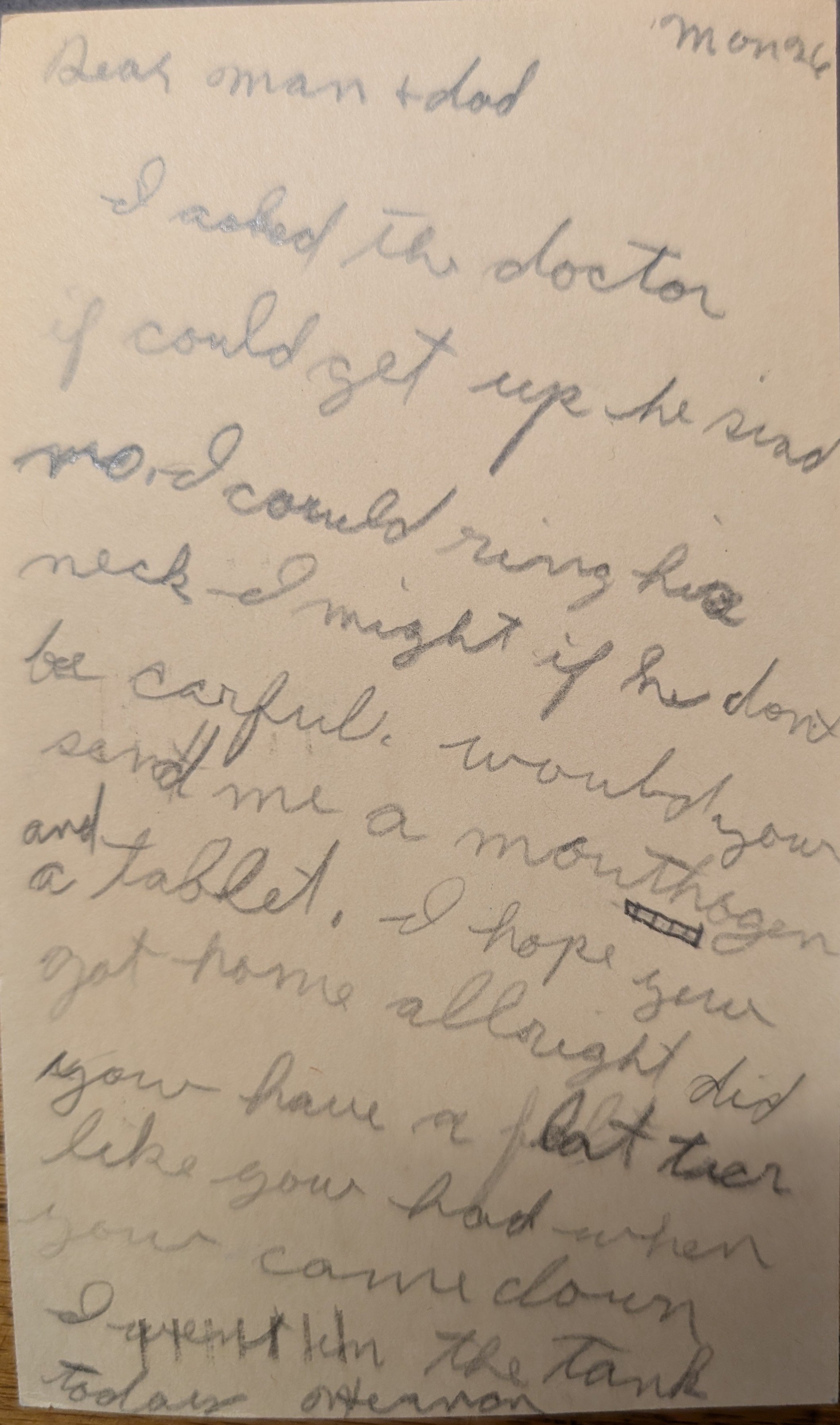
February 22, 1942: “There was a boy that got the red mesels [measles]. He went over where I was. We all got a shot in our hip so we won’t get the mesels [measles]. I can sit up more now. I am not walking yet.”
March 9, 1942: “I am only getting hot packs on my back, shoulders, and two legs. They put them on so hot that [it] bruns [burns] a guy. I think that sister K [is] crazy. I mean it.”
April 4, 1942: “I am getting along fine. My right leg is stronger now. They are starting to put on packs before we eat in the morn. The nurse that is on now is crazy to suit me. She woun’t even let us talk when she puts on hot pack[s]. There are 16 kids getting packs.”
July 30, 1942: “It is raining out this morng. It was real cold last night. I can get up and walk now.”
September 2, 1942: “I am so busy that I don’t get time to write. I walk two or three times a day get six rounds of hot packs a day so you see I don’t get much time to right [write]. I might be home in a week or so because they say that they are not suppose[d] to keep polios here no more than 6 months.”
September 9, 1942: “I can come home now. I will have to go to Eau Claire ortho. School. I have to come back in three months. Well I am glad I can go home.”
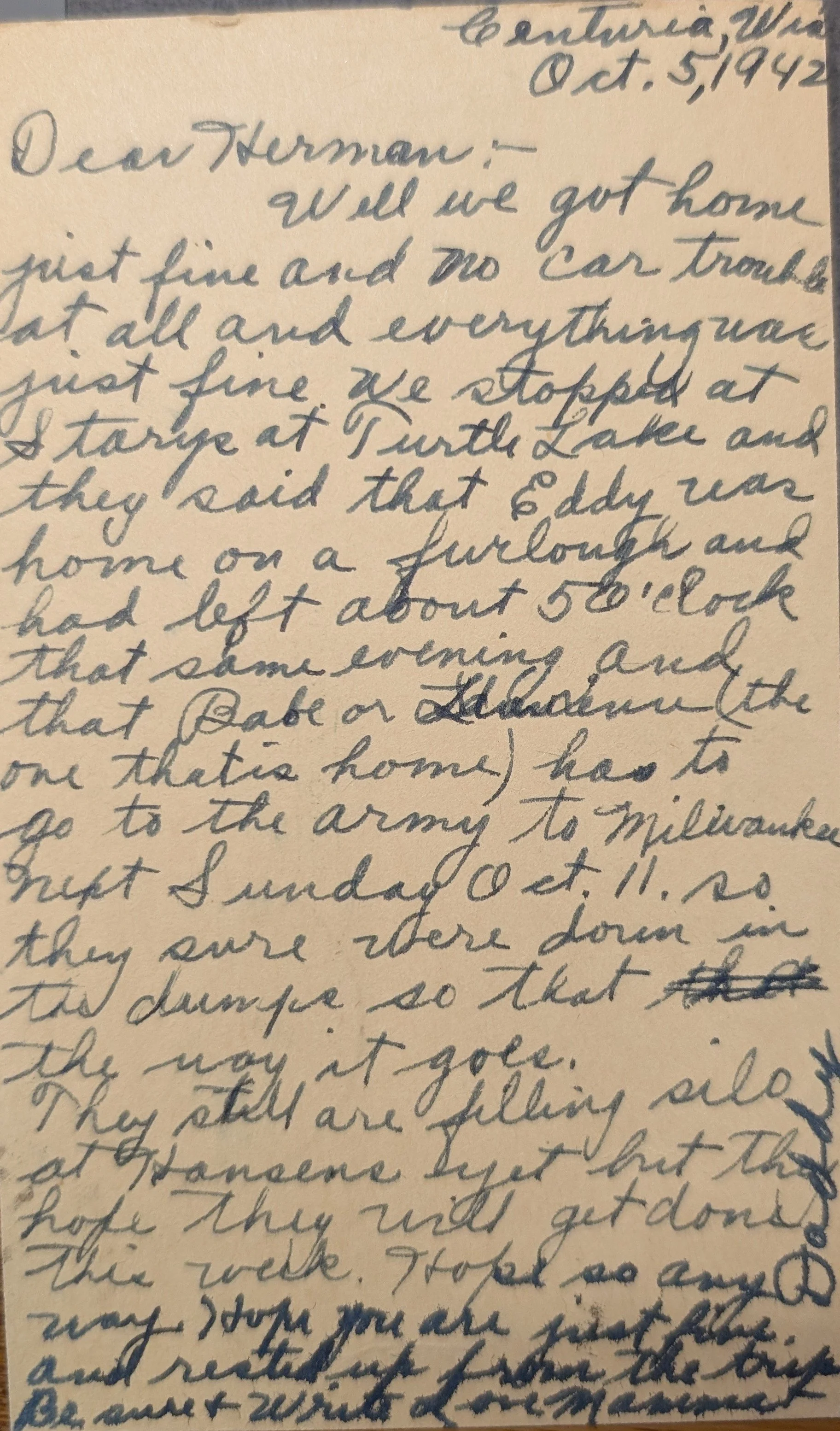
Postcard from Herman’s mother to Herman, October 1942
October 8, 1942: “I got your card tuesday and was glad to hear that you got home o.k. I didn’t have to go to school yesterday because Doctor Bruns was here from Madison to look the kids over. I just came from there thats why.”
December 4, 1942: “I got back from Madison Wed. night about 8:00. I am sopposte [supposed] to go back to madison December 30, 1942. it will be in my Xmas vacation wright before New Years. They got about 6 in. of snow (Madison) going down the track [truck] brock [broke] we had to wait about 1 hour then the engen [engine] brock [broke] we wait[ed] about 1 hour.”
December 8, 1942: “It was about zeoro [zero] out this mornging [morning]. When I went to Madison on the trian [train] it was two hours late getting in to Madison. Am I going to come home on a bus or are you coming after me in the car. Well geuss [guess] [I] will have to stop. Love Herman”
This ends the postcards from Herman Geis to his parents during his hospitalization for polio treatments from 1941-1942. This was only a selection of the transcribed postcards Herman sent. Herman went to
school while in treatment. He met and made friends. And he always ended his postcards with love to his parents.