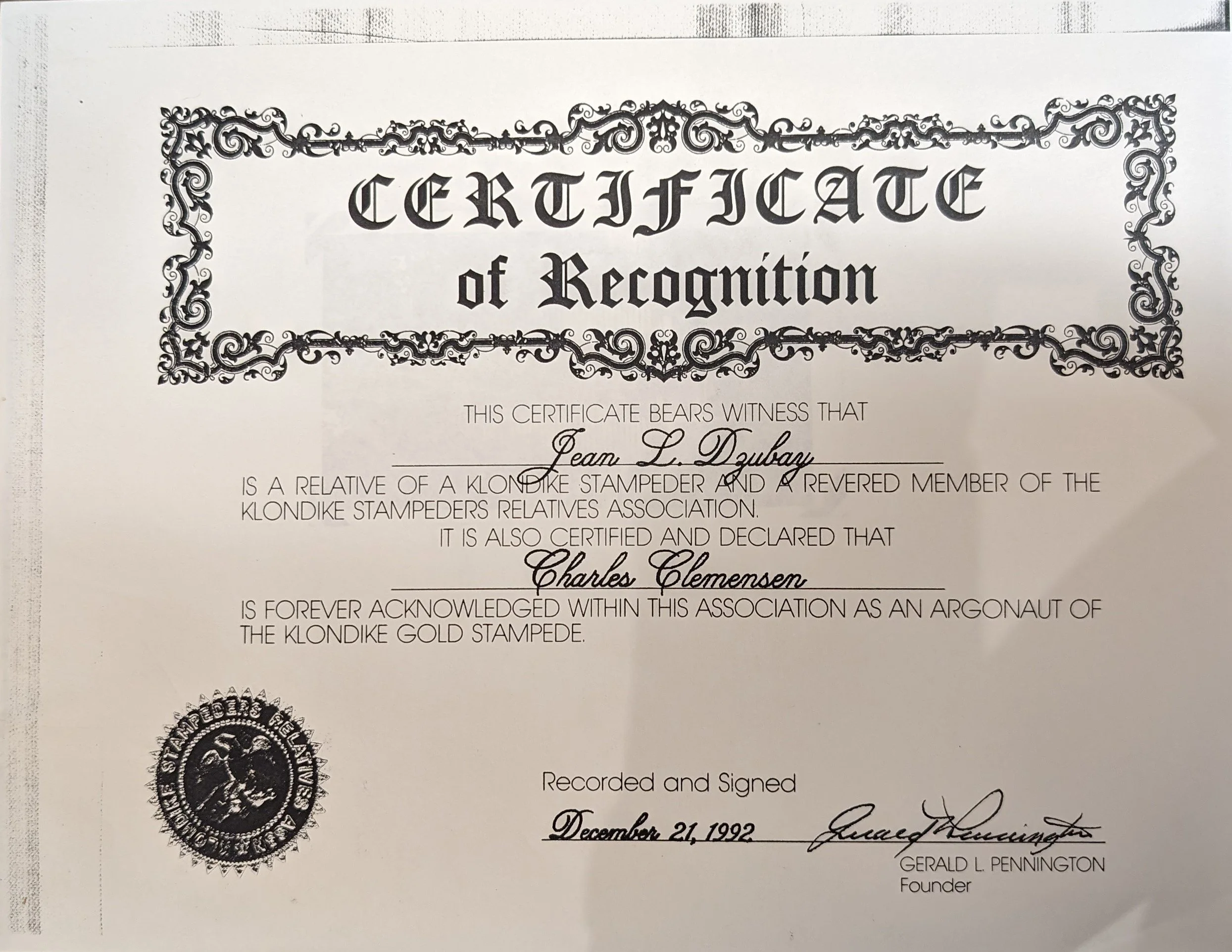
When organizing the thousands of documents in our archives, we often come across fascinating news stories, correspondences, and, in this case, genealogical stories.
The following story was written by John “Jack” Clemenson, son of Charles Clemenson, the protagonist in our story. Charles was born in Lolland Denmark in 1864. In 1882 Charles began his journey to the United States. Charles spent $80 and took the three-week journey from Denmark to New York confined in one room on board a ship. Most of the other men on board were confined to this same room, spent most of the journey ill and in bed, and were fed boiled potatoes and tea lowered into the room in a kettle on a long rope. Upon arriving in New York, Charles immediately came to Deer Park, Wisconsin to visit his brother Paul. Charles gained employment with the St. Croix Lumber Company at South Stillwater (now Bayport) during their logging season (April to November) for fifteen years. What follows is a collection of some of his experiences while living and working in the area, with a specific focus on gold-digging trip he took to the Klondike.
Charles worked a variety of logging jobs including scoot tender, sled tender, skidway tender, oxen driver, log turner on skidway, steamer, roustabout, surveyor. He also worked in a variety of places between 1883 and 1911 including Stillwater, MN, Gordon, WI, Spooner, WI, Spring Brook, WI, Kennen, WI, New Richmond, WI, Williston, ND, and the Klondike.
According to Charles, he ended up in North Dakota due to issues with his boss in Bayport. Charles reportedly told his boss to “go to hell” and his boss sent him there.
During each of his stays in the logging camps, there was a specific routine for Charles and his fellow loggers to follow. Lights on at 5:30 AM, off at 9:00 PM except Saturday nights. The camps had a stag dance every Saturday night with a mouth organ and/or a fiddle for music. Sundays were left for washing and mending. Beds in the camps were double decked, two men to a bunk, with pine boughs for mattresses and two blankets (one over and one under). Breakfast every day consisted of meat, potatoes, hot biscuits, coffee, and tea. Lunch in the woods consisted of beans, meat, potatoes, bread, pie, and tea. Dinner at camp included beef, potatoes, bread, sauce, tea, and coffee and was served promptly at 6:30 PM.
In February 1898, Charles and a group of 11 other men left Stillwater for the Klondike. Each person in the party was provided 1,200 pounds of food, two blankets, one tarp, and a tent for four people. Each person was also issued a hand sled, pick, shovel, gold pan, axe, and crosscut saw for two people. Overall, the cost per person was $110. The group arrived at Lake Bennett in April 1898 with all their gear, including a recently purchased horse, and waited for the ice to break up.
Once the ice broke up, Charles and his group traveled north to Dawson, with more purchases including hiring a Native American guide to get their boats (and gear) across a set of dangerous rapids for $25 per person. Prices in the Dawson area were high, even by 1898 standards and everything was paid in gold dust.
From their hand-built log cabin outside of Dawson, Charles and a small group of men took a 100-overland trip to the headwaters of the Klondike River to search for gold. They built a raft to travel back down the river. The group made it approximately 25 miles back downriver before their raft hit a submerged log and overturned where they lost almost everything but their blankets in the process. Charles could not swim but was saved by grabbing a bundle of blankets and floating to shore. One member of the party was in bad shape and was sent downriver with two moose hunters in a canoe who happened to come by just after the accident. The other seven party members purchased some moose meat from the hunters and started the long hike back. Unfortunately, all their matches were soaked in the accident and they had to survive on raw moose meat and wild currants on the three-day trip back.
Charles took a few jobs in 1899 and 1900, one on a producing gold mine. Charles was the bottom man in a “drift,” digging up gravel. He would build a fire in the hole in the evening, which would burn all night to thaw out the gravel to be hoisted out the following day. The ground was constantly frozen and thus they needed to burn their way down.
News traveled slow in the late 19th and early 20th centuries, particularly if you were a gold miner way up in the Klondike. So, if someone got their hands on a newspaper, it was a big deal. However, folks also took advantage of that fact. Charles found himself the victim of someone looking to make a quick buck. A man came to Dawson, and he managed to get his hands on a newspaper from another passenger that came up in a boat. This man proceeded to rent a building and advertised that he would read the paper on a certain night for a $2.50 admission fee. Charles and others fell for it and went to get the news. But this man sensed the opportunity to make more money so he read one page then announced he would read another page the following evening…for a $2.50 admission fee. Thankfully it doesn’t seem like Charles fell for it a second time.
In the fall of 1900, Charles was in Dawson watching someone unload a boat of supplies and decided on a whim to ask for a job on the boat. Within an hour, Charles had left Dawson, and the Klondike, behind to head back towards Polk County, Wisconsin. Charles returned to Osceola on September 26, 1900. He then purchased forty acres of land in Black Brook township (near Amery) and moved his family up there. He eventually accumulated 200 acres of land and spent the remaining days of his life on the farm until he passed away on October 30, 1943.