Wisconsin's First Cooperative Creamery

“Organization Artikler”

I. Vi Undertagnede Nelson Lawson, Jorgen P. Skow, Hans P. Christensen, Jorgen Jensen, Martin Chr. Jensen, Paul Nielsen, og  Peter Larson, alle af Polk County, Wisconsin, herved forener os selv I det Oimed at operette en Korporation I henhold til de-Reviderede Love af States Wisconsin, I den Hensigt at bygee eie og drive et Creamery (Mereri) med nodvendige Tilbeboro I Town of Luck, I Polk County, Wisconsin.

II. Korporationens Navn skal vaere “Luck Creamery Company.” Det Skal vaeregeliggende I Luck, Polk County, Wisconsin hvor dens Hovedkontor skal vaere.”

And so read the first two paragraphs of the articles of incorporation of the first cooperative creamery in Wisconsin. Presided over by the Justice of the Peace J.P. Peterson and recorded at the Register of Deeds office on April 14, 1885, these two paragraphs were printed in the Polk County Press on November 18, 1885. On December 12, the articles were again published, this time in English.

The first Directors were listed as: Nelson Lawson, Jorgen P. Skow, H.P. Christensen, Jorgen Jensen, Martin C. Jensen, Paul Nielsen, and Peter Larson.  From this first board of Directors, Jorgen P. Skow was elected president, Nelson Lawson, secretary, and H.P. Christensen the vice president. All the incorporators were Danish, who, true to their tradition, believed that in union there is strength. The creamery was built on the north shore of Little Butternut Lake but was later moved, inch by inch, to a second location a half mile north of what is now the village of Luck.

Sign marking the site of the original creamery building

A little more information about the work of the creamery: Mrs. Andrew Ravnholt was the first butter maker and Hans Hjort was the second. Each farmer in the cooperative owned a share and the cream was purchased from the members. Cream in those days was not paid for by test but by the inch and neither was it picked up and delivered in trucks. The farmer put the milk in cans, which had glass tubes or gages on the side which were marked down to one-eighth inches. The cream as shown by the gage was measured and paid for accordingly. The cream was then skimmed off and the farmer kept the skimmed milk.

And thus, in Luck, was born a cooperative organization that has continued to the present day, and its example was adopted by many groups of dairymen throughout the County.

In 1965, a letter was written to the Wisconsin State Historical Society by Frank Werner, the Chairmen of the Polk County Historical Site Committee. The committee asked for a marker to be placed on the site of the first cooperative creamery in Wisconsin. The committee worked for years and in 1970 their dream was realized when the Wisconsin Historical Society erected a marker at the site.

Danish Dairy Cooperative sign, erected 1970

The Many Miles Travelled by Polk County's First Car

After several owners, a 5 and 1/2 year restoration, a cross country trip, and a visit to Frederic, Polk County’s first automobile, a 1902 Oldsmobile, has moved to Europe. The late Gary Hoosbeen, founder of the Curved Dash Olds Club, and his wife Nancy, visited Frederic when he owned the Olds in 2012, stopping by the 1901 SOO Line Depot.

The article below by Hoonsbeen, describes the interesting history of this car, from being possibly Polk County’s first car, purchased new in 1902 for $650.00 to its March 2016 sale by Bonhams Auctions, to a European collector for $51,250.00. Thanks to Mark Hoonsbeen, Minneapolis, MN for information offered.

William Johnson, Frederic Area Historical Society

1902 Curved Dash Oldsmobile

1902 Curved Dash Oldsmobile

Gary and Nancy Hoosbeen driving the 1902 Olds in Frederic, by the 1901 SOO Line Depot

Gary and Nancy Hoosbeen driving the 1902 Olds in Frederic, by the 1901 SOO Line Depot

1902 CURVED DASH OLDSMOBILE, The first car in Polk County.

It was in the summer of 1902 that Balsam Lake’s town doctor, James D. Nickelson, purchased a new Curved Dash Oldsmobile from the A. F. Chase agency in Minneapolis for $650.00.  It was likely the first car ever brought to Balsam Lake and maybe even to Polk County.  This is Dr. Nickelson’s original car.  It was restored in 1980.

A former Milltown resident, Clarence Nelson, recalls in a December 30, 1978 interview, that one day in grade school, about 1904, they heard a strange noise outside on the road.  The teacher, Martha Nelson, from Star Prairie, took the kids outside to watch Dr. Nickelson drive by in this little 1902 Oldsmobile.  He remembers the teacher commenting they may never have another chance to see an automobile! 

Dr. Nickelson had two daughters, Dorothy and Helen.  Dorothy married Walter Anderson and Helen married Mr. Parks from Centuria.  The Parks family were funeral directors.  Helen’s husband was an auctioneer and hardware dealer.  The doctor later became Milltown’s postmaster and lived in a converted Shell station in that town.

Clarence recalled that Dr. Nickelson had the Oldsmobile when he moved from Balsam Lake to Milltown in about 1906 or 1907.  About 1908 the Oldsmobile was sold to the Milltown depot agent, Olaf Martin Lund, uncle to the man who years later founded the famous Lund Boat Works.  Olaf left Milltown under some controversy that same year, driving the Oldsmobile back to his home town of Twin Valley Minnesota.  In a 1985 letter, Olaf’s brother, 92-year-old Oscar J. Lund, recalls the trip across Minnesota, “The drive from Milltown must have been at least 500 miles and then mostly on dirt roads.  I have gathered that my brother had driven to Wanamingo and then drove to visit my Dad’s brother, Rollof Lund, northeast of Wanamingo.  I recall my brother mentioned that he had driven through farm fences and what-not to get there.  Then I surmise that in doing so he had to drive over the covered bridge on the Zumbro River which has become a historical site”.

Olaf Lund continued to drive the 1902 Oldsmobile until about 1912 when it was replaced with a newer vehicle.  It sat in the family barn until about 1918 when it was sold to a junk dealer as part of the scrap-metal drive for WW1.   His brother Oscar was not happy about this so retrieved it from the junk yard for $2.00 and put it back in the barn where it sat until 1965.

The Lund’s sold their farm and auctioned off the equipment in 1965 and the little Oldsmobile was purchased by then state Senator Norm Larson, of Ada, Minnesota, for a sum of $125.  Still in deplorable conditions from old age, the Oldsmobile again changed hands and moved to Oslo, Minnesota, selling this time for $2100.

In 1977 Gary Hoonsbeen, Minneapolis, purchased the car and after 5-1/2 years of work, restored it to near original condition.  In 1985, Hoonsbeen drove this Oldsmobile from San Francisco to New York, a distance of 3844 miles, over a 38-day period.  The Olds averaged 12 MPH traveling about 100 miles each day, including several hundred miles on the Interstate system in the Western United States.  The car was appropriately named “OSCAR” for this trip, and it has the record of being the oldest model automobile ever cross country.

The car has only 1 cylinder, 4 inches in diameter, developing 4 and 1/2 horse power.  Power is transferred to the rear axle with a block chain.  It has two speeds and reverse using a planetary transmission, implemented many years before Ford used it on his automobiles.   The top speed is about 25 miles per hour, maybe 30 with a good tail wind.  It burns regular gasoline and consumes about 1 cup of oil every 50 miles.  The tires have inner tubes with a size of 28 x 3 inches.  Originally, it had wooden spoked wheels but they were in very poor condition and were replaced with wire wheels, which were an option in 1902.  It is steered with a “tiller,” one of the last automobiles to use this type of equipment.  About 20,000 Curved Dash Oldsmobiles were built between 1901 and 1907 of which nearly 1000 still survive in collector’s hands today.  It sold originally for $650.  On good roads it will carry four adults but it takes several minutes to get up to “full” speed.  Two or three may be required to walk going up hills.

Clarence Nelson and Oscar Lund both lived into their 90’s-long enough to have rides in the restored 1902 Oldsmobile, making the restoration work all worthwhile. 

By:  Gary Hoonsbeen, Minneapolis, MN - June 10, 2004

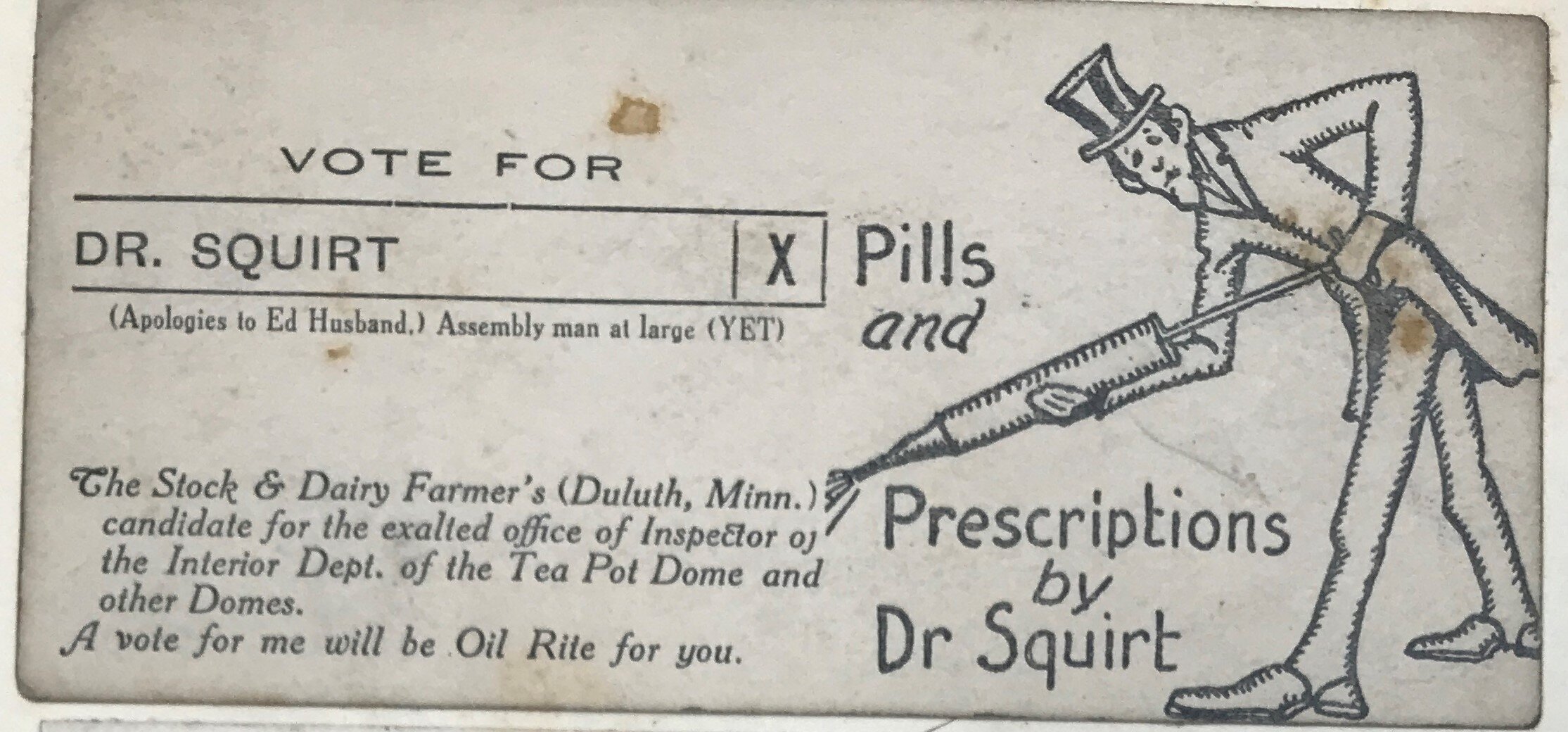
The Life of Roy Jack Hennings, "Doc Squirt"

The Polk County Historical Society brings to you an interesting character and favorite son from Cushing. Doc Squirt is best know for his articles in local newspapers during the early 1900’s and is claimed to be the first person in the county to own a motorcycle. Here you will read about the life of Roy Jack Hennings.

Roy Jack Hennings aka “Doc Squirt” was born in Osceola on October 24, 1883 to Andrew and Lina Hennings. Roy had one brother and three sisters. While he was a young boy, the family moved to the pioneer town of Cushing and opened a hardware store.

Growing up in Cushing, Roy helped out on his father’s farm and delivered the mail. In Roy’s late twenties he started a Harley Davidson motorcycle dealership in Cushing and it is believed that he had the first ever motorcycle in the area.

DocSquirt1.jpg
Doc Squirt’s motorcycle created quite a stir around Cushing. He possibly had the first motorcycle in the area. He carried the mail on his rural route through wet clay and sand. Here is Doc Squirt, alias Roy Hennings, on the left, stunting on his mot…

Doc Squirt’s motorcycle created quite a stir around Cushing. He possibly had the first motorcycle in the area. He carried the mail on his rural route through wet clay and sand. Here is Doc Squirt, alias Roy Hennings, on the left, stunting on his motorcycle. With him is John Skone, a friend and cousin.

The “famous son” legend can be attributed to the nickname that evolved for Roy, “Doc Squirt”. Myrtle Smith Coyle, Roy’s sister tells this story, “Roy had not yet learned to dance, when a masquerade ball came up, and it seemed to appeal to him. He wanted so much to go to it, but he didn’t know what to wear.” What the boys came up with was a cutout white coat and a tool bag which they covered with black oil cloth and stenciled ‘Dr. Squirt’ on it as well as on the back of the coat. She goes on to say, “Throughout the evening, he was trying to operate on everyone and, of course, no one had any idea whom he was because he had never gone to dances, but he was sure having a ball and so was everyone else watching him. And, by the way he won the prize.” “From that night on, he was Dr. Squirt and he was known all over the country-side.”

There are many other stories by old-timers how the Doc Squirt legend began. One story is that he was at a bobsledding party running around with a squirt gun. Others say that Roy played a role in a play at school in which the character’s name was Dr. Squirt.

An example of Roy’s humor.

An example of Roy’s humor.

Roy was known to be quite the prankster. “The people that were on the receiving end probably never forgot,” a Dresser man stated, “No one was really safe with Squirt around, he was always looking for a chance to pull something.” One of Roy’s alleged pranks was placing carpet tacks on a car seat. Other incidents included lighting off dynamite after a wedding and also setting off the whistles at the town’s creamery and sawmill in the middle of the night.

Roy Hennings poses proudly at the wheel of his auto, “Silent Sarah” – or was it “Leaping Lizzie?” He made his mail rounds on the unpaved roads around Cushing in this vehicle for a time – it was about 1915. Horse and buggy and motorcycle made earlier…

Roy Hennings poses proudly at the wheel of his auto, “Silent Sarah” – or was it “Leaping Lizzie?” He made his mail rounds on the unpaved roads around Cushing in this vehicle for a time – it was about 1915. Horse and buggy and motorcycle made earlier “rounds”.

Dr. Squirt (Roy Hennings) who was managing the Cushing Tigers when this photo was taken in 1908, stands at the left. He gave the “Tigers” their name, according to Abe Skone, after the Detroit Tigers had won the championship despite being the smalles…

Dr. Squirt (Roy Hennings) who was managing the Cushing Tigers when this photo was taken in 1908, stands at the left. He gave the “Tigers” their name, according to Abe Skone, after the Detroit Tigers had won the championship despite being the smallest town in their league.

Roy was also known to be a notorious “nicknamer”, in his columns he referred to F.D.R. as “Frank Deficit” others include a saloon outside of Cushing he referred to as “Hell’s Half Acre”, his friend Ed Smith “King Faithless”, and “Handy Pete” for Pete Peterson.

 In the early 1900, Doc was the manager of the Cushing Tigers baseball team. The team consisted of nine players and if one player got hurt the game was over. The team had a traveling musical band that played during the games.

Roy didn’t stay in one place for long. He worked log drives and then headed out West to harvest fields going as far as the state of Washington. For some time he was selling real estate from Texas to Canada. His brother, Norman Hennings stated, “There weren’t many place he didn’t live a while.”

Mrs. Severson of St. Croix Falls describes it as a sort of “Will-o-the-wisp” way of life.  She says, “One person would say he’d seen Squirt here, at the same time someone else thought he’s seen him somewhere else.” Legend lends that he may have been a spy or an agent for the Secret Service because of his constant moving.

Doc logged in northern Minnesota, Wisconsin and Canada in the winters. He referred to logging as “working in the woods”. His sister remembers, “when he came down with the other loggers on the drive in the spring he carried a peavey hood and wore cork shoes with nails in them.” Later, Roy would donate a pair of logger’s river drive boots with nails in them, a pike pole and a logger’s “Stetson” hat to the Minnesota Historical Museum. Roy was a huge admirer of Paul Bunyan. Below is one of Doc’s articles about a log drive.

PaulBunyon.jpg
DocSquirt2.jpg

Roy Henning may be best remembered as a free-lance writer. For most of his life he wrote newspaper articles for a variety of publications across the country. If he was not writing for local newspapers, he would still send his columns back home from where ever he was.

His first columns appeared as the “Cushing News” in 1909 in the Polk County Ledger. Doc was only 20 years old. “Doc Squirt Writes From the West, From The Pen Of Doc Squirt, By Heck’, ‘Prof Heck and Brimstone Bill” were other names of his columns. He briefly wrote for dailies in Milwaukee and St. Paul. While in St. Paul he had a run in with the police and for his punishment it is told that he taught the Minneapolis police how to ride a motorcycle on sand roads.

Here Doc offers his view on drinking in the March 1910 column:

“Three cheers to Taylors Falls for voting out saloons. Now is the time for St. Croix drys to agitate the question and they undoubtedly will. The argument the wets advance in St. Croix is that their saloons are run orderly. While that may be true, the fact remains that the people who really pay those licenses and keep those saloon keepers in luxury are, in some cases, doing so at the expense of their families. There is water in abundance for the brethren of the burning thirst; they will like it when they get used to it.”

Roy was involved in a lot of newspaper publications, “Henning had a hand in starting up a newspaper in Milltown in the early years of this century (1900).” “Thru Polk County on a Motorcycle” is the title of a small pamphlet from The Milltown Herald on June 10, 1915. Henning writes, “Four miles south of Alabama one meanders into the wide awake burg of Cushing, the home of Venerable Dubs, Handy Pet, Broncho Lewis, Hardware Sue, Hawkshaw the detective, and yours truly, Doc Squirt. With considerable pride I call your attention, dear readers, to the fact that Cushing is some town with the accent on the some. Anyone coming into Cushing and making a big noise will always find some one on the job there that can make just as much racket as they can.”

Dr. Squirt with his trademark, broad-brimmed hat, seated in the car at Nels Smiley’s farm. (EE Husband Collection -PCHS Archives)

Dr. Squirt with his trademark, broad-brimmed hat, seated in the car at Nels Smiley’s farm. (EE Husband Collection -PCHS Archives)

Henning enlisted in WWI in 1918, he was assigned to be a motorcycle dispatch rider. However, the war quickly ended after his enlistment and he never went overseas. Roy spent the rest of his army career in Norfolk, VA as a military policeman, guarding the base supply depot. Years later he wrote this:

A lot of people seem to think that there is another war brewing somewhere in the present time. They claim that all signs point that way but when one thinks back on the horrors of the last war one cannot but hope that the youth of today will be spared the making of the big sacrifice. War is a terrible thing and no amount of oratory that is spouted a good safe distance from the battle lines can make anything else out of it.
— Doc Squirt

Doc Squirt is known to be the original promoter of the annual Polk County Picnic. This picnic started out as a gathering of friends and family of George Hanson into a countywide event. The picnic was usually held at a park in St. Croix Falls. The picnic was one of Doc’s favorites and “he would write it up long in advance, and afterwards, give accounts of those who attended and in time, these numbered in the hundreds.

In 1935 Doc moved out West, but continued to correspond with friends in Polk County. Letters and reminders are on display at the Dr. Squirt County Historical Society, now the Sterling Eureka and Laketown Historical Society in the Cushing Community Center in Cushing.

“Head-line Ed” Husband of Balsam Lake, was a good friend of Hennings. Here he holds the “Squirt Piano”, which is what Roy called his trusty old typewriter.

“Head-line Ed” Husband of Balsam Lake, was a good friend of Hennings. Here he holds the “Squirt Piano”, which is what Roy called his trusty old typewriter.

Also on display is Doc’s “piano”, his typewriter, at the Polk County Historical Society in Balsam Lake.  After Roy’s death, “no one else could make it work,” the typewriter was “literally tied together with string and rubber bands.” In 1941, Doc wrote, “Quite a lot of the readers have had a good laugh at our little old “Squirt Piano” as our portable Corona is called all over the Midwest and South. It’s the greatest and possibly the most tied together little writing device in the world…”

Roy Henning “Doc Squirt” passed away on Sept. 20, 1942, following an operation to remove a brain tumor in Portland, Oregon. A memorial was held at the Cushing Lutheran Church and his final resting place is at the Tamarack Cemetery. His obituary reads, “The death of Roy Henning is regretted by hundreds of friends who knew him better by his nickname “Doc Squirt”. Possessed with an unusually keen memory of people he became acquainted with, he numbered as a friend of hundreds in nearly every state in this union.”


Resources

Braatz, Rosemarie, Hanson, Russ, Henning, Norman, Swanson, Lester. Doc Squirt, The Life and Times of Roy Jack Hennings, Cushing Wisconsin’s Most Famous Son. Sterling Eureka and Laketown Historical Society, 2006

Hennings, Roy. Dr. ‘Squirt’ Moments. Roy Hennings, 1942

Sterling Eureka and Laketown Historical Society. (2000). General format. Retrieved from https://sites.rootsweb.com/~wiselhs/index.html?fbclid=IwAR0VJsH-e0lTqIGjimVirUShreCq-FIJJ_B1r62PUO_hD5PpI0Zkz9tOo8Q